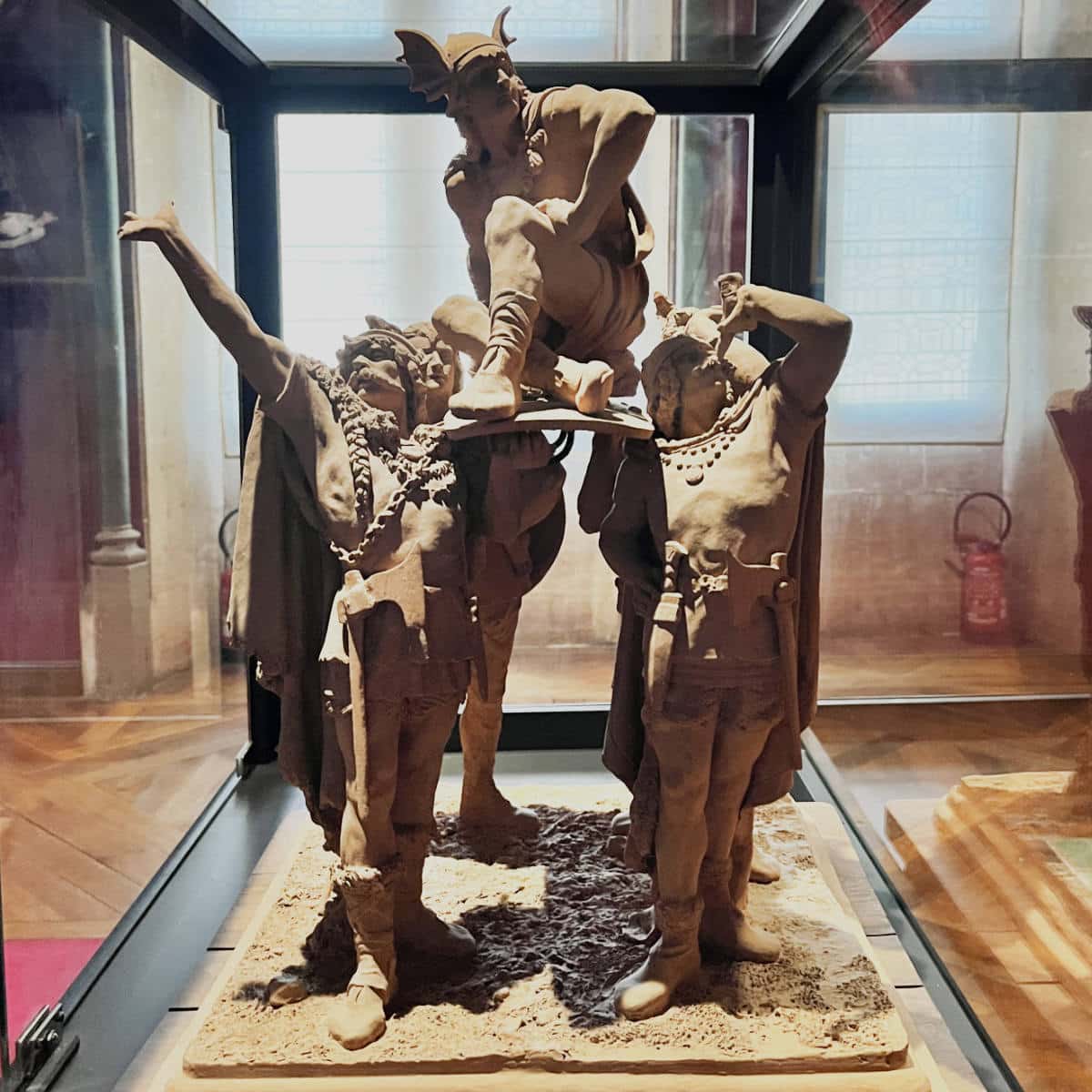
Merovingian royal dynasty: the mysterious legend
If you are wondering where you heard that name “Merovingian” before, you may be remembering your Dan Brown novels. The books claimed that Mary Magdalene who arrives in Provence (see her tomb here) carrying Jesus’s child, marries their descendants into French nobility and becomes the Merovingian Royal line.
It is Merovech after whom that the Merovingian dynasty is named after. However, not much is actually known about Merovech, the man.
Merovech’s life as described by Gregory of Tours
Merovech (known in French as Mérovée) was the King of the Salian Franks. They became the most dominent Frankish tribe at the same time as the Romans Empire was declining in ancient Gaul.
Born around 411AD, most of what was recorded was written about him comes from the 6th century historian Gregoire of Tours. And Gregoire only mentions him in passing while busy embellishing the past of Merovech’s possible descendant Clovis I, the King who converted France to Christianity.
I say possible because Merovech could have been Clovis’s grandfather, uncle, a cousin, a distant relative, etc. (We know that Clovis’s father was Childeric I, but many other details are not entirely verified, including who Childeric was descended from.)
The identity of is Merovech’s wife and Childeric’s mother is unknown.
The name ‘Merovech’ can be translated as “famous in combat” or “famous fighter” from Frankish “mére” meaning “reputation” and “vech” meaning “combat”. So it stands to reason that, if nothing else, he was a powerful lord.
Mythical Legends
Merovech’s story was written to inspire awe. For the medieval people, Merovech was born through a supernatural event, as his mother was said to have been impregnated by a sea creature, often described as a Quinotaur. This legend gave rise to the epithet “Merovech’s sea-born” and added a mythical aspect to his lineage.
Another fantastical legend is to claim that Merovech was a great-grandson of King David to give himself divine legitimacy. But there is no no ancient source connecting Merovech (or any Merovingian) to David or any other biblical character.
Attila the Hun and the Battle of Catalaunian Plains
Perhaps what sealed Merovech’s fame was the tale of his fight against Attila the Hun. The Battle of the Catalaunian Plains (also called the Battle of Chalons) took place in 451AD, towards the end of his reign.
Attila had already burned his way across northern Gaul, and everyone knew this was the last chance to slow him down.
Some historians think that King Merovech commanded the Frankish tribes while allied with the Roman General Aetius and Visigothic king Theodoric I, to defeat Attila the Hun in 451 near Orlèans.
The Franks fighting on the Roman side, not against it, signaled a shift in the Gaullic tribes within the former Roman empire. The battle itself was brutal and indecisive on paper, but strategically decisive: Attila withdrew from Gaul and never seriously threatened it again.
For Merovech, the fight cemented his reputation as a legitimate war leader and helped position his descendants as heirs aligned with Rome. The Frankish Salians tribe would become the dominant tribe in the area.
As such the Royal Merovingian dynasty is named after him, and with him the beginnings of the Frankish Empire, eventually claiming their right to rule France.
Royal Kings and dynasty
Merovech is presumed to have died around 457 or 458AD. His successor was Childeric I, believed to be his son.
And it is Childeric’s son (Merovech’s grandson) Clovis I who really put the Merovingian dynasty on the map. Clovis is usually considered the first true king of the Franks.
Clovis converted to Christianity around 496, a move that won him the backing of the Gauls, Romans and the Catholic church. Clovis unified much of Gaul and turned the Franks from a loose warrior tribe into a powerful kingdom.
After Clovis, Merovingian power slowly eroded. Kings still ruled in name, but real authority passed to the mayors of the palace, who controlled the armies and the treasury. By the 7th century, Merovingian rulers were dismissed as the “rois fainéants”, while the mayors and a certain Charles Martel ran the state.
Charles Martel is famous for stopping the Umayyad forces near Tours/Poitiers in 732AD. His victory halted further northward expansion of Muslim armies into Frankish territory.
Because of this famous victory Martel’s family rose inside the Merovingian system. Charles Martel never took the royal title, but his son Pepin the Short completed the takeover in 751, deposing the last descendant Merovingian king, Childeric III.
Pepin’s son, the Holy Roman Emperor Charlemagne, was not a Merovingian by blood, but he considered himself Merovignian’s political heir.
He inherited the Frankish kingdom that Clovis had created, ruled the same core lands, and defended the same Church, consciously presenting himself as the continuation.
Hair as a symbol of power
Merovingian kings were known as the “long-haired kings.” Hair wasn’t fashion, it was considered sacred royal power. Cutting a king’s hair equaled stripping him of legitimacy.
In order to claim power, Charlemagne’s father deposed the last Merovingian king, Childeric III by shaving his royal hair in 751AD . This was a symbolic execution without the blood. Charlegmagne’s dynasty became known as the Carolingian dynasty.
Living descendants
Childeric III is considered to be the last Merovigian King. Although there may be Merovigian descendants living today out the wider branches of the family tree, they are not considered famous or counted among the royal claimants to the French throne.