
Road tripping in Germany
Germany is one of those places where you can spend the morning exploring a medieval town, the afternoon visiting a historic castle and the evening enjoying a traditional meal in a little village restaurant. And with so many different things to explore, a great way to maximize your vacation is by renting a car and heading on a road trip.
Germany is actually relatively small and several attractions are within 2-4 hours of each other. Driving there is generally straightforward, and the road network is excellent. There are, however, a few things worth knowing before setting off.
1. The Autobahn isn’t all unlimited speed
Germany’s famous Autobahn network has sections without a mandatory speed limit, but plenty of sections have restrictions, particularly around cities and roadworks. The recommended speed (Richtgeschwindigkeit) is 130 km/h where no limit is posted, but can be as low as 90km/h in many places.
There are also stretches along the highway were electric cars have a higher speed limit than others. Always watch the signs, as speed restrictions change very frequently.
2. High gas prices
One of the shockers of driving around Germany is the price of gas. In the summer of 2026, it was around €2.7 a litre in peak summer on the highway compared to around €2/litre in France. To compare apples to apples, that would be:
- Germany – $11.75 USD per gallon
- France – $8.7 USD per gallon
- Canada – $5.3 USD per gallon
- U.S. – $4.5 USD per gallon
3. No toll roads
While gas prices may be high, the good news is that there are no general motorway tolls for private cars. All highways are owned as public-entities and there are next to none toll roads (unlike France.) And unlike Austria or Switzerland, Germany does not require ordinary passenger cars to purchase a special motorway vignette.
4. Watch out for environmental zones
Some German cities have environmental zones (Umweltzonen), where vehicles need an approved emissions sticker (Umweltplakette) to enter. This can apply to foreign-registered cars too.
Check the rules before driving into city centres, particularly if you’re using an older vehicle. You may want to park your car in the outskirts of a town and head into the center on public transport.
5. Pay to use the toilet
And to add to the pain at the pump, you also have to pay to use to the toilet at the highway rest stops in Germany. There are little turnstiles at the entryway where you have to put in €1 for each person.
I cannot even imagine how annoying this would be if I was traveling with potty-training toddlers who get car sick (been there), let alone older kids.
The explanation I heard from a friend is that Germany doesn’t have toll roads like France, and so must get money from somewhere, which would be ‘toilets’. (I will point out that even non-tolled roads in France usually have free toilets rest stops.)
6. The “Ausfahrt”
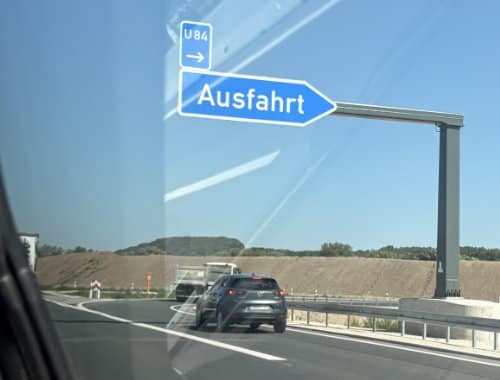
Continuing on the highway, my favorite quirk is the “Ausfahrt”. It means “exit” as in you are exiting the highway. And this sign is everywhere.
The problem is that the sign points out the exit, but the name of the exit of where we are exiting was a few 100 meters earlier. So if you missed the name, tant pis pour toi (too bad for you), you find yourself in a panic of whether you should exit or not.
Keep track of the names on your car or phone GPS in order to reduce the confusion. You don’t have to go home, but you have to ausfahrt out of here.

7. American radio stations
A fun surprise while driving in Germany is that we stumbled upon an American radio station on the car radio. It took some googling to figure out why all of sudden we were hearing American accents chatting away on the radio, but apparently this is the American Forces Network (AFN) radio for the approximately 35000 U.S. troops based in Germany. (There are no U.S. troops in France.)
8. Parking can be complicated
In historic towns, parking directly in the centre is often difficult or restricted. Look for designated car parks outside the old town walls and walk the remaining distance. It’s usually easier than trying to navigate narrow medieval streets.

When is the best time for a German road trip?
Germany is a year-round destination, but the experience can be quite different depending on when you visit.
- Spring (April–May): A lovely time for sightseeing, with fewer tourists than in summer. The weather however can be unpredictable so pack accordingly.
- Summer (June–August): The best time for outdoor activities and visiting the sights on foot. It is the busiest period, particularly around popular tourist towns.
- Autumn (September–October): Particularly beautiful in the Black Forest and Rhine Valley, when the vineyards and forests change colour. September is also a good month for exploring without the peak summer crowds.
- Winter (November–February): Germany’s Christmas markets are a big attraction, particularly in towns such as Rothenburg, Nuremberg and Dresden. However, shorter daylight hours and possible snow and ice make driving less appealing.
For a first road trip, I’d choose May, June or September. You can mix historic castles and medieval towns with more child-friendly attractions, including Europa-Park and Legoland. In addition, Germany has hundreds of castles, many with charming villages and fascinating stories.
One thing I’d recommend is not changing hotels every night. Germany’s towns are often best enjoyed at a leisurely pace, and staying two nights in one place gives everyone a chance to unpack, explore and enjoy.