French word of the day: Allemand
Published: April 23, 2026
We are finally having a sunny week here in the Paris region, which is good because the kids are on school holidays yet again. (Yes, this amount of school holidays is very difficult to manage.)
Sunny weather always makes me think of summer holidays, and I’ve been pondering potential road trips that are possible from the Paris area. Because when you look at the map, Paris to Barcelona is about the same driving time as Toronto to New York.
But as much as I can decipher a sign in Italian or Spanish, it is the country next door, Germany, that I get quite lost in. German is just not obvious as a language that one can seemingly muddle through.
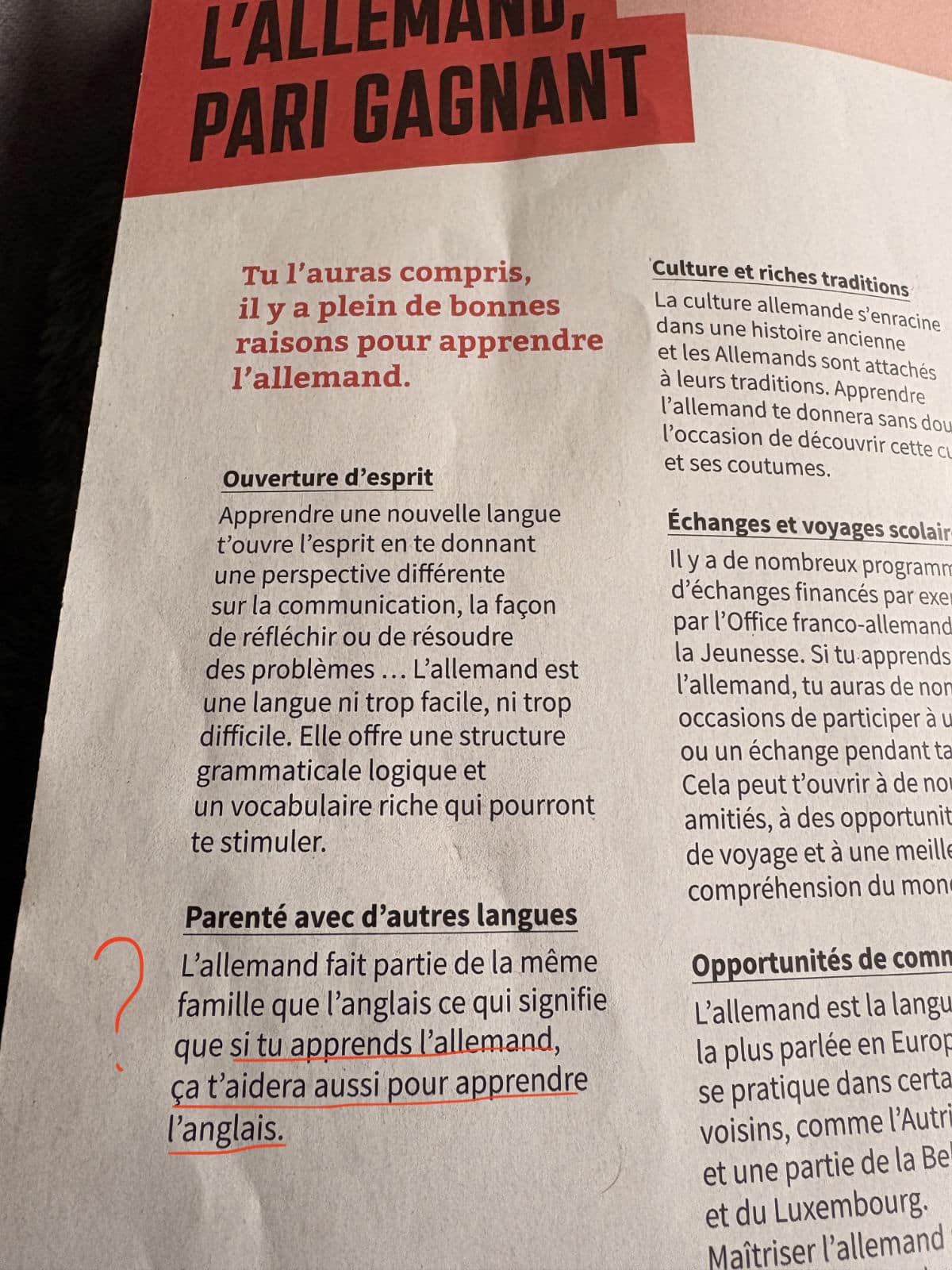
But with both Germany and Switzerland on our doorstep here in France, German is one of the main languages that many French people learn in school (including many of my friends).
It all dates back to the famous “1963 Élysée Treaty, signed by General de Gaulle and Chancellor Adenauer” to not plunge the continent (and world) into another Franco-German war.
The treaty obviously is working as we have several friends who have moved and settled in Germany, as well as German people who moved here. But those are 40-something adults.
These days, French kids learning German is not obvious as all. According to government statistics, around 600k students in 1994 took German as their 1st language in middle school, compared to a mere 140k in 2022. And there are a ton of newspaper articles decrying the decline of the language of Goethe in France.
Have I mentioned, middle school is coming for us? Known in France as collège, this is the moment 10-year-olds have to pick 2 languages to continue onward all the way through high school. Not one, two.
In France, taking English in school has always been more-or-less required. But picking a 2nd language alongside? The choice in most schools around the country is: Spanish or German. And Spanish is currently winning by a knockout 70%.
To me as a North American, trying to learn 2 foreign languages at the same time, 3 along with French grammar, seems crazy. But there are plenty of Europeans who speak multiple languages and start learning them all at a young age.
In addition, French middle and high schools also often offer languages like ancient Greek, Latin and Italian, later in 8th and 9th grade. My 40-something anglophone brain is recoiling in horror at attempting to learn all these languages at the same time, but those archeologists and historians have to come from somewhere!
So what to pick? As a Roman language, French is more closely related to Spanish, having both descended from Latin. German is whole ‘nother beast. (Let’s just eliminate ancient greek from the list for the moment, shall we?)
Anecdotally, for people my age in France, it was obvious for their parents to put them in Allemand (German) rather than Espagnol (Spanish). Not because of a treaty or aspirationally because their parents wanted them to speak German, but rather because fewer kids stuck to German and this guaranteed smaller class sizes.
But these days, schools mix both groups so there is no longer the advantage of smaller class sizes. (And before we get too excited about learning languages, I will also note that the French education system is in angst at the moment because in global maths test rankings like PISA and TIMMS, French kids have fallen sharply off in recent years and are at the bottom among EU countries, below the U.K, Canada, Australia, and the U.S.)
I am nothing if not the type to ponder these types of decisions so with the need to make an informed choice, I recently started having a go at Duolingo German (not a sponsored post) to compare it to my “vamos a la playa“ and “una cerveza por favor“ skills.
And I will say, German is tough. What is interesting is that the French government, referencing that 1963 treaty, is promoting learning German as “coming from the same family as English…and helping to learn English”. Umm, right.
I suppose there are a lot of English-German sounds that are in common, but given my duolingo struggles, this newsletter is not going to come out in German anytime soon.
I do have a streak going, but I confess I do often hand it off to the kids to manage for me. And the little sponges love it. So in the end I may just have to rely on their translation skills as we drive around Europe…
In other news:
- Disneyland Paris has opened a new “Frozen” section a couple of weeks ago, which President Macron went to inaugurate. There was an Olaf robot that had a bit of a traumatizing (for a 4-year-old) malfunction, but otherwise it seems to be the new place to check out this summer.
- In gossipy news, Jordan Bardella, the likely far-right presidential candidate in next year’s French election, is dating the Princess Maria Carolina of Bourbon-Two Sicilies. He’s 30 and leading in the polls, she’s 22 and speaks 6 languages, Paris Match and Tatler are all over it.
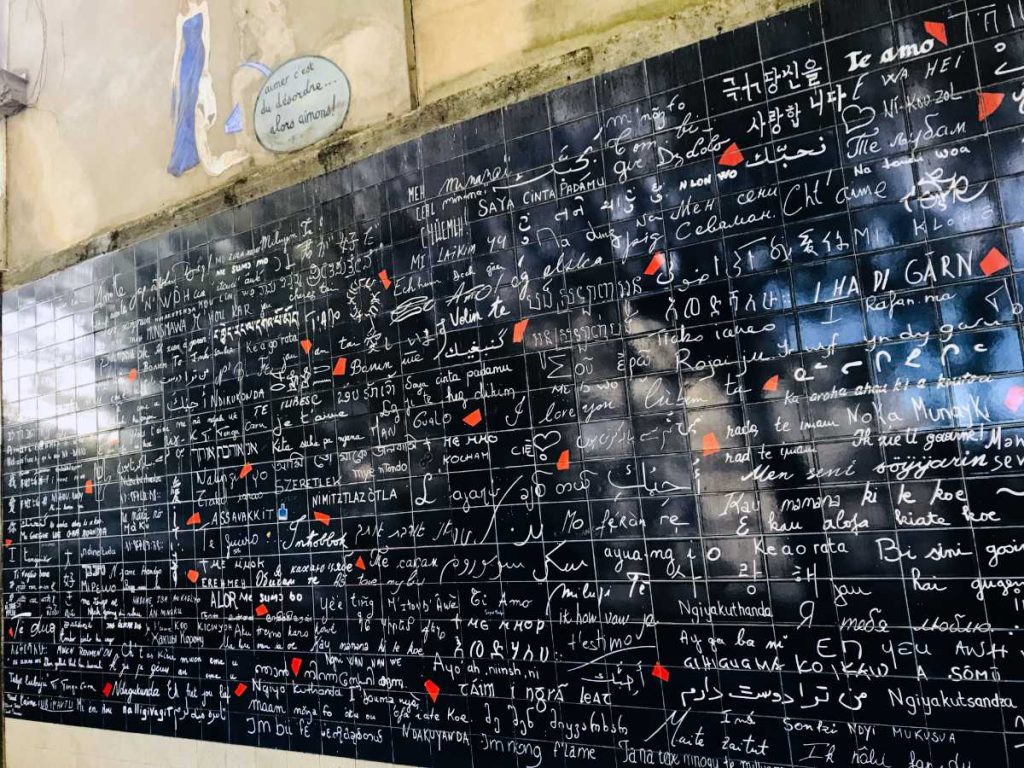
- The I-love-you wall in Paris (an Instagram staple for tourists) is now behind a barrier because it risks crumbling.
And in the blog:
Arles: From Roman settlements to Van Gogh in southern France
Explore Arles with its historic Roman ruins and provencal architecture that so inspired Vincent Van Gogh. With top things to see and do, best hotels, and more.
Pork loin roast with French mustard marinade
Roasted in the oven, this delicious French-style pork loin roast is cooked in a rub of garlic, herbs and mustard for maximum flavor.
A classic with a twist, this salmon spinach quiche is easy to make in advance and serve any time of the day.