
Elections in France
France is a republic and proud of it. The country that guillotined its royal family during the 1789 French Revolution, has a strong political culture with many parties vying for power.
In many other countries they’re only 2 or 3 parties hoping to elect a President and political representatives. In France, a strong electoral system and 2 rounds of voting mean that there are many power blocks which then form coalitions to govern.
While it may sound complicated, the electoral process has proven its democratic merits. So let’s explore the different government elections in France, shall we? Allons-y!
Presidential elections

- France is a representative democracy and the President is elected as Head of State.
- Elections are held every five years. (Before 2000, French presidential terms were 7 years.)
- The President of France is elected by a direct vote from the public.
- Two-Round System: Presidential elections use a 2-round system. In the first round, all candidates compete. If no candidate wins more than 50% of the votes in the first round, a second round is held a week later between the top two candidates.
- The official residence of the French President is the Palais Elysées in Paris.
☞ READ MORE: “Vive La France” and other French Presidential Vocabulary
Legislative elections
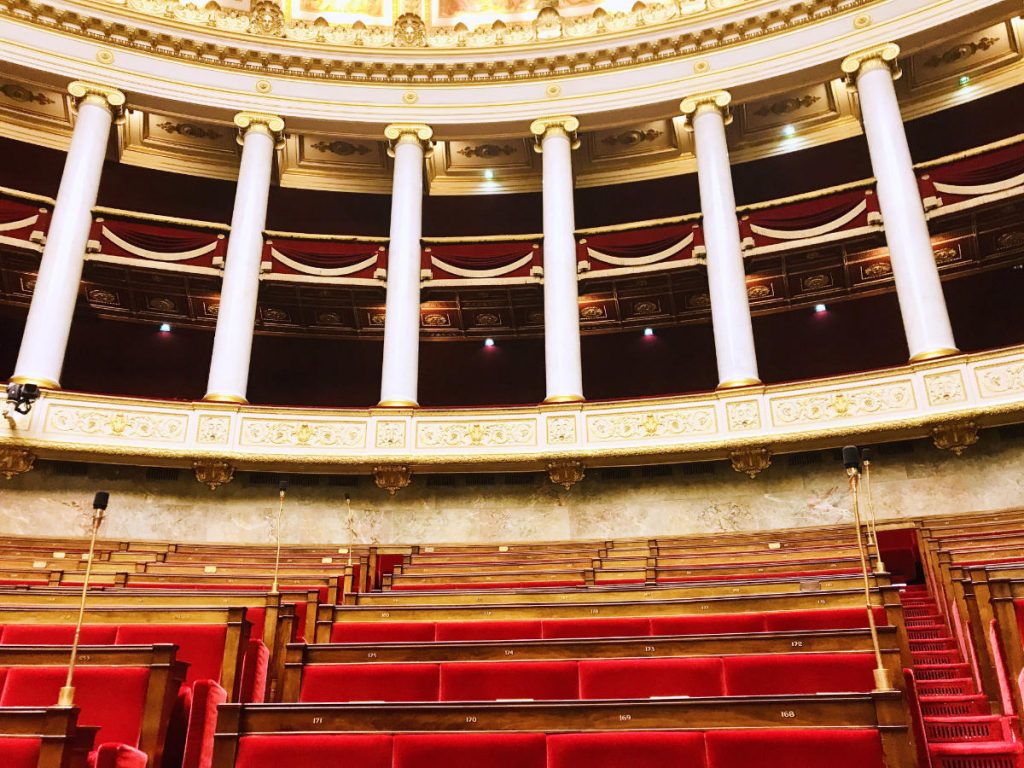
- The National Assembly is the lower house of France’s Parliamentary system, with the Senate considered the upper house.
- There are 577 parliament members are directly voted into the Assemblée Nationale (French House of Representatives).
- Elections are held every five years, usually a few weeks after the presidential elections.
- The deputies elect a “President of the Assemblée Generale” who opens and closes the parliamentary session, as well as animates the debates and enforces the rules.
- New legislative elections can be called by the President, but not within 1 year of an election.
- Two-Round System: Like in the Presidential elections, deputy candidates use a two-round system. In the first round, all candidates compete. If no candidate wins more than 50% of the votes in the first round, a second round is held between the top two candidates.
- Only France’s Prime Minister is allowed to address the Parliament members at the Assemblée Nationale, not the President. (This is similar to the Queen/King of United Kingdom who are not allowed into the British House of Representatives unless invited.)
- The President of the Assemblée Nationale still has apartments for use at the Palais de Versailles, along with official apartments in Hôtel de Lassay in Paris.
Senate
- The Senate is the upper house of the French Parliament, and is not open to direct voting by French citizens.
- Instead, locally-elected officials elect 348 Senators to sit in the Sénat for 6-year terms, with half of the seats up for election every 2 years.
- To unite both houses of government, the Congrés of Versailles is held in the Salle de Congrès at the Palace of Versailles. During these occasions, the President of France addresses both houses of Parliament, the Assemblée Nationale (House of Commons) and the Sénat. (This is similar to the Queen’s speech in the United Kingdom and the State of the Union in the United States.)
- For comparison:
| Data Points | France | United States |
|---|---|---|
| Population | 66 million | 328 million |
| # of Representatives | 577 | 435 |
| # of Senators | 348 | 100 |
Prime Minister
- The elected President of France appoints a Prime Minister as his head of government, with the support of the elected deputies in the Assemblée Nationale.
- The Prime Minister selects ministers for cabinet posts such as interior, defense, health, culture, housing, etc.
- If a majority 289 legislative deputies vote against the Prime Minister, he/she and the cabinet no longer hold the confidence of the Assemblée and they must resign.
- While each presidential term is 5 years, most prime ministers are only appointed for a portion of the presidency, usually around 2 years or less.
European Union elections
- EU elections are held every five years to elect members to the European Parliament. These are not held at the same time as presidential or legislative elections.
- European elections in France are timed to be held at the same time as in other EU countries.
- Elections are always on a Sunday, and there is only one round of voting, unlike other French elections.
- Proportional representation is used in European Parliament and parties gain seats in proportion to the number of votes they receive.
Local Elections
The regions in mainland France are subdivided into 96 departments. The departments are further divided into over 35,000 communes (meaning towns).
Some towns have as little as 20 people in them, but still have their own communal government and mayor.
Regional elections
- Purpose: Elect members of the regional councils.
- Frequency: Held every six years.
- Responsibilities: Regional councils manage economic development, transportation, education (high schools), and regional planning.
Departmental elections
- Purpose: Elect members of the departmental councils.
- Frequency: Held every six years, often staggered with regional elections.
- Responsibilities: Departmental councils oversee social services, middle schools, local infrastructure, and certain public health initiatives.
Municipal elections
- Purpose: Elect mayors and municipal councilors.
- Frequency: Held every six years.
- Responsibilities: Municipal councils are in charge of local services like urban planning, local policing, school affairs, and community events. They also manage local budgets and development projects.
Two-Round System: Similar to national elections, local elections also use a two-round system if no candidate or list wins an outright majority in the first round.
Loi PLM: In the municipalities of Paris, Marseille and Lyon, a combination of arrondissement elections and majority bonus (similar to the U.S. electoral college) works to elect the mayor of the city. This law has been eliminated for the 2026 elections.
Getting out the vote
- Eligibility: All French citizens aged 18 and over can vote. Overseas French citizens also have the right to vote.
- Voter Registration: Citizens must be registered on the electoral roll. Registration is generally automatic for young people when they turn 18.
- Vote on Sunday: French Elections are always held on a Sunday, making it easier for people to vote without work commitments. (Shops and restaurants are usually closed on Sundays across France, other than in large touristy urban areas.)
- If a winner does not get more than 50% of the vote, then the first 2 candidates with the highest % of votes compete in the 2nd round of voting that is held 2 weeks later.
- In certain cases a “triangular” is declared if the 3rd place candidate gains a large % of registered voters’ vote.
- Runoff Voting: The two-round system can lead to strategic voting, where voters may support a less popular candidate in the first round to help their preferred candidate in the second round.
- Voting is not compulsory, but it is generally quick and easy. A week before, voters receive an envelope containing pamphlets outlining each candidate’s position.
- Turnout: French elections often see 60-75% turnout, reflecting public engagement in politics.
On voting day: Small pieces of paper are laid out with each candidate/party name on separate pieces of paper.

Voters collect all the papers, go into a covered booth and put the paper with the candidate of their choice in a little envelope, while throwing out the other candidates’s chits of paper in a nearby dustbin. (If you are really curious, you have peek into the dustbin to see which candidate is seemingly not being voted for.)
There is no voting confusion here since there is nothing to checkmark, hanging chads, etc., just a slip of paper with the candidate’s name in an envelope.
As such, votes are counted by hand in France. (It is, however, not great for the environment with all that wasted paper!). A form of protest during the vote is to turn in a vote blanc, meaning “white (blank) vote”.
Campaign period
- There are strict rules about when campaigning can happen. Campaigns officially start a few weeks before the election day.
- The campaigns end at midnight the Friday before the election.
Media coverage
- There are regulations to ensure fair media coverage for all candidates. This includes equal time on television and radio.
- On election Sunday, by law, no polls can be published, and no electoral predictions, publications or broadcasts can be made.
- The first official estimate of the results are legally allowed to be published at 8pm Paris time on Voting Sunday.
- Due to time zones differences, voters in overseas territories and French expatriates vote earlier at their local French embassy so as not to discourage voter participation in these places.
Other government bodies
- Conseil d’État serves as both the highest administrative court and a legal advisor to the French government. It ensures that administrative actions comply with the law and reviews proposed legislation for constitutionality. This dual role helps maintain legal integrity and protect citizens’ rights against governmental misuse of power.
- Conseil Constitutionnel is the highest constitutional authority in France. Its duty is to ensure conformity with the Constitution establishing the 5th republic as well as the Declaration of the Rights of Man and of the Citizen and the preamble of the constitution of the Fourth Republic.
- National Commission for Campaign Accounts and Political Financing (CNCCFP): This commission oversees the financial aspects of campaigns to ensure transparency and fairness.
Read more: