
Ile d’Aix: historic holiday island
Located in the department of Charente-Maritime in Nouvelle Aquitaine, Ile d’Aix is a perfect destination for history lovers and nature enthusiasts.
With cars banned on the island, this tranquil island remains one of France’s best-kept holiday secrets.
Where to stay
History
The island was first inhabited by monks after a convent was set up here in 1067 during the early Middle Ages. The island later became a crucial military stronghold due to its strategic location at the mouth of the Charente River.
During the Hundred Years’ War (1337–1453), Île d’Aix suffered from repeated invasions and pillaging between the French and the English. In the late 17th century, under the reign of Louis XIV, the renowned military engineer Vauban fortified the island extensively.
In 1757, during the Seven Years’ War, the British launched an attack on the island and destroyed much of its fortifications. The island was later rebuilt and further reinforced in the defense of nearby Rochefort, which was a major naval base for France.

Île d’Aix’s most famous historical moment came in 1815 when Napoleon Bonaparte spent his final days on French soil here before surrendering to the British. After his defeat at the Battle of Waterloo, Napoleon fled to Rochefort, hoping to escape to the United States.
However, with British ships blocking his passage, he ultimately surrendered and was later exiled to Saint Helena, marking the end of his rule. Today, the house where he stayed has been converted into the Napoleon Museum.
In more recent times, Île d’Aix played a role during World War II, when German forces occupied the island, using its fortifications for military purposes. Following the war, the island gradually transitioned from a military stronghold to a peaceful retreat known for its natural beauty and historical significance.
Things to do
Vauban’s fortress
One of the island’s most famous sites is Fort Liédot, designed by famed French military engineer Vauban to strengthen coastal defenses.

The fortress was completed in 1704 and played a key role in France’s military wars against the English.
Napoleon museum
The museum is housed in the building where Napoleon Bonaparte spent his final days in France. From 12 to 15 July 1815 after the defeat at Waterloo, Napoleon spent his last days in France at the house, before being transferred to the island of St. Helena.

The house was bought by Baron Napoleon Gourgaud, great grandson of General Gaspard Gourgaud (1783-1852), who was present when the Emperor left the Île d’Aix ,and who would follow him to Saint Helena.
Baron Gourgaud managed to assemble at the museum a collection of artefacts, including original letters, period furniture, military uniforms, and personal items that once belonged to Napoleon.
The museum today is under the management of the Napoleon museum at Malmaison, just outside Paris.
Beaches
You can’t come to Île d’Aix without heading over to one of the island’s pristine beaches.

The most popular ones include Plage aux Coquillages and Plage de l’Anse de la Croix, where visitors can swim, sunbathe, and enjoy the unspoiled coastline.
Priory Saint-Martin
This historic church dates back to the medieval period and is one of the oldest structures on the island.

Once a center of religious life, Priory Saint-Martin is now a tranquil site where visitors can wander around on their way to the outskirts of the main village.
Lighthouse
The island’s lighthouse, Phare de l’Île d’Aix, provides a fantastic vantage point to view the surrounding water and the nearby Fort Boyard.
It is right next to the beaches, so you can split up into a party of adventurers and party of beachgoers.
Bike rides
Since motor vehicles are not allowed on the island, cycling is the best way to explore Île d’Aix.
Rent a bike and take a leisurely ride along the scenic coastal paths. Most of the island is quite flat, making it quite easy to cycle along.

Local specialties
The area is famous for its seafood, with a deep tradition of fishing. Oysters, in particular, are a highlight. Try a platter of freshly shucked oysters served with lemon or a mignonette sauce for a quintessential experience.
Another favourite is moules frite, a dish of mussels cooked in a broth or cream sauce, and served with Frech fries.
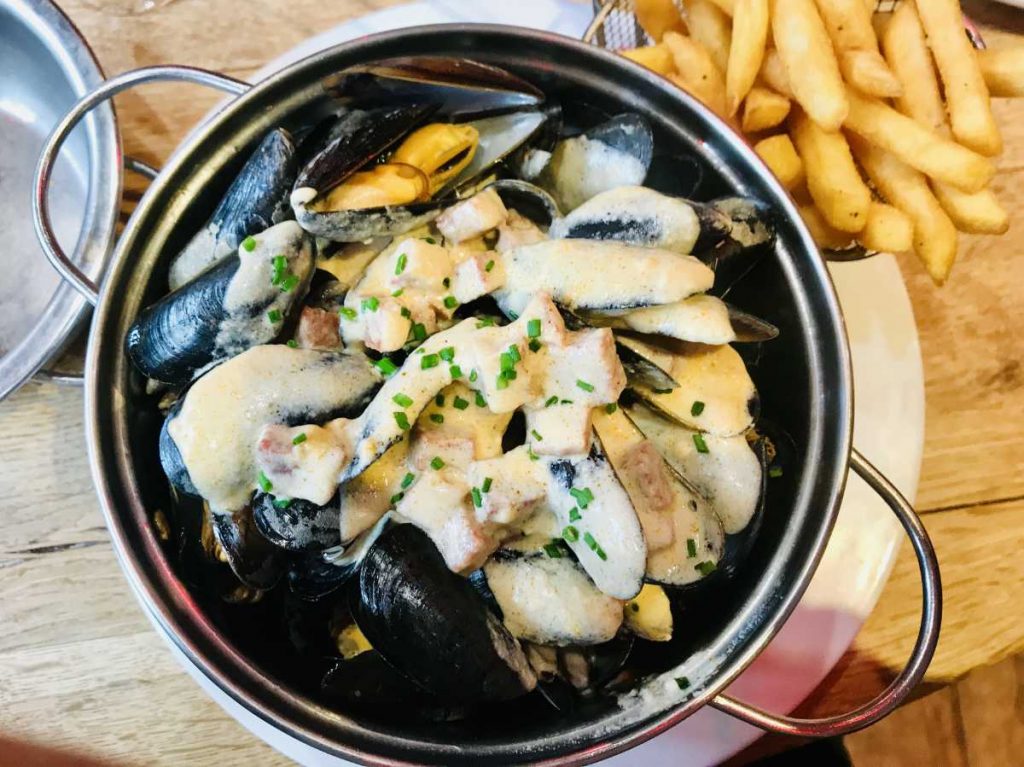
The area is also famous for its salt production, and its fleur de sel is a staple in French kitchens. Take home a bottle of fleur de sel as a souvenir.

The area is also is known for various digestifs such as Cognac and Armagnac which are types of brandies. In addition, try a Pineau des Charentes, a fortified wine made by blending grape juice with cognac and aged for years.
Nouvelle-Aquitaine is also home to the Bordeaux wine region, with plenty of locals wines available to indulge in.
How to get to Ile d’Aix?
Ile d’Aix is about 315 miles (505 km) from Paris. The fastest way to get there is by taking a train from Paris Montparnasse station to La Rochelle, with the journey taking around 2h30 on a high-speed TGV.
The nearest airport is on the mainland in La Rochelle, offering flights to major cities across Europe, making it easy to reach Ile d’Aix from various destinations.
From La Rochelle, you will need a ferry to get to Ile d’Aix. Once on Ile d’e Ré’Aix, it is relatively easy to bike all over the island, with plenty of bike rental shops around.
How many days should you spend?
You can probably visit the main sights of Ile d’Aix during a day, with enough time left over for lunch and to head to a beach. But there is plenty to do in the area, so don’t hesitate to spend a few days on the island.
Where should you stay?
There are is only one recommended residence around Ile d’Aix where you can stay, called the Résidence Pierre & Vacances Le Fort de la Rade.
If you wish to stay on an island, try Ile de Ré next door, which has more tourist accommodation:
- €€€ – Hôtel Restaurant Le Grand Large (Rivedoux-Plage)
- €€€€ – Atalante Relais Thalasso & Spa – Wellness Hôtel (in Saint-Marie-de-Ré)
- €€€€€ – HR Hôtel-Restaurant & Spa Marin (in La Flotte)
If you prefer to stay on the mainland, here are some recommended hotels in La Rochelle:
- €€€ – Greet Hotel La Rochelle Centre
- €€€€ – Maisons du Monde Hôtel & Suites
- €€€€€ – Maison des Ambassadeurs